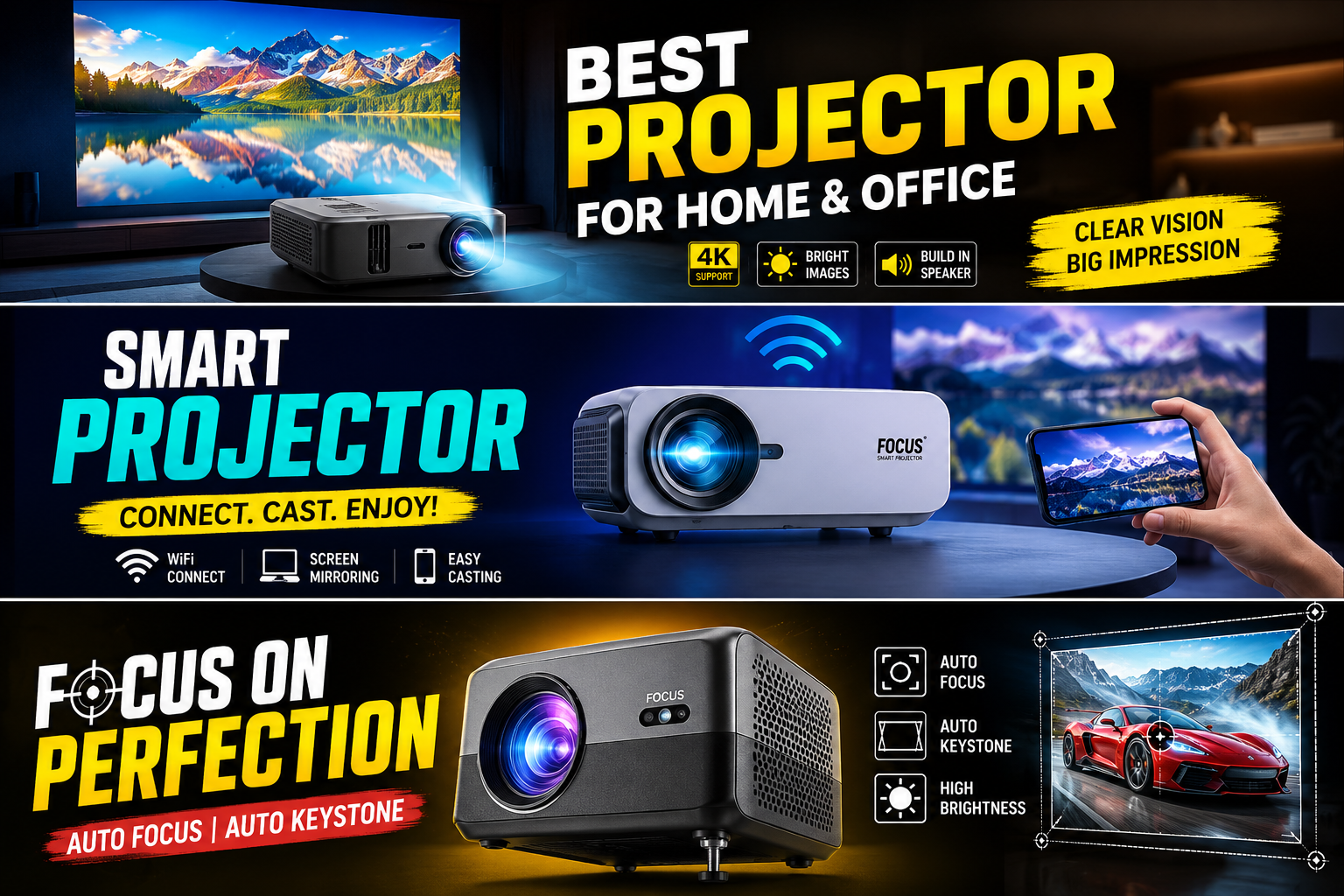
If you are searching for the best home theatre projector 4K, you need to understand important features such as resolution, brightness, contrast, throw distance, projector type, and sound.
A projector can turn a normal room into a large entertainment screen. Instead of watching movies on a small TV, you can enjoy a 100-inch, 120-inch, or even larger picture at home.
Today, projectors are also useful for offices, classrooms, meetings, presentations, gaming, and entertainment. However, an office projector and a home cinema projector are designed for different purposes.
In this guide, we will explain everything in simple English so you can choose the right projector for your needs.
What Is a Home Cinema Projector?
A home cinema projector is designed mainly for watching movies, TV shows, sports, and other entertainment content on a large screen.
Unlike a normal office projector, a home theatre projector focuses more on:
- Picture quality
- Color accuracy
- Contrast
- 4K resolution
- HDR support
- Quiet operation
- Large screen sizes
- Movie and gaming performance
A good home cinema projector can create a theatre-like experience in your living room or dedicated movie room.
For example, a 100-inch or 120-inch projection can make movies feel much more immersive than watching them on a standard television.
Home Cinema Projector vs Office Projector
Before buying a projector, it is important to understand the difference between a projector for an office and one designed for a home cinema.
Read More:- https://technicalkeshab.com/best-earbuds-under-2000/
Projector for Office Use
Office projectors are mainly designed for presentations, documents, spreadsheets, charts, and meetings.
For office use, brightness is often very important because meeting rooms may have lights or windows.
An office projector should offer:
- Good brightness
- Clear text
- Easy setup
- HDMI and USB connectivity
- Reliable operation
- Good performance in rooms with ambient light
For presentations, Full HD resolution can be more than enough. You may not need to spend extra money on a 4K home theatre projector.
Projector for Home Cinema
A home cinema projector is designed for movies and entertainment.
Here, picture quality becomes more important than simply having a very bright image.
A good home theatre projector should provide:
- High resolution
- Strong contrast
- Accurate colors
- HDR support
- Good black levels
- Low fan noise
- Large-screen performance
For a dedicated dark room, you usually do not need the highest possible brightness. Too much brightness can also reduce the comfortable cinema experience.
What Is a 4K Home Theatre Projector?
A 4K home theatre projector is designed to display very high-resolution images with much more detail than traditional 1080p projectors.
4K is especially useful when you want a large screen. On a 100-inch or larger screen, higher resolution can help movies, sports, games, and other content look sharper.
However, there is something important to understand: not every projector advertised as “4K” uses a native 4K imaging chip.
Some projectors use pixel-shifting technology to create a 4K-like image, while native 4K projectors use a true 4K imaging system. Pixel-shifting models can still produce excellent pictures, but buyers should check the manufacturer’s specifications carefully.
Why Choose a 4K Projector for Home Theatre?
There are several reasons to consider a 4K projector.
1. Sharper Picture
The biggest advantage is detail.
A 4K projector can show fine details in movies and high-resolution video more clearly than a standard 1080p projector.
This becomes more noticeable as the screen gets larger.
2. Better Movie Experience
Movies look more impressive on a large screen when the image is sharp and detailed.
A good combination of 4K resolution, strong contrast, accurate colours, and HDR can create a much more cinematic experience.
3. Great for Gaming
A 4K projector can also be a good option for gaming.
However, gamers should not look only at resolution. Input lag, refresh rate, HDMI features, and gaming modes are also important.
4. Future-Proof Choice
If you plan to use your projector for many years, choosing a 4K-capable model can make sense because more streaming services, games, and video sources now support high-resolution content.
How Bright Should a Home Cinema Projector Be?
Brightness is one of the most important projector specifications.
It is normally measured in lumens, but you should pay attention to how the manufacturer measures brightness. ANSI lumens are useful for comparing projector brightness more consistently.
A dark home theatre does not necessarily need an extremely bright projector. Projector Central notes that premium home theatre projectors can have brightness below 3,000 ANSI lumens because excessive brightness is not always ideal in a dark room.
As a general starting point:
| Room Type | Suggested Brightness |
|---|---|
| Dark cinema room | Around 1,500–2,500 ANSI lumens |
| Living room with some light | Around 2,500–3,500 ANSI lumens |
| Bright room | 3,500+ ANSI lumens |
These are general guidelines, not strict rules. Screen size, screen material, viewing distance, and room lighting all affect the result.
What Is Throw Distance?
Throw distance means the distance between the projector lens and the screen.
This is very important because different projectors need different amounts of space to create the same screen size.
Long-Throw Projector
A long-throw projector needs more distance between the projector and screen.
It can be a good choice for a dedicated home theatre where you have enough room.
Short-Throw Projector
A short-throw projector can create a large image from a shorter distance.
This can be useful in smaller rooms.
Ultra-Short-Throw Projector
An ultra-short-throw, or UST projector, can sit very close to the wall or screen while producing a large image.
This makes UST models attractive for living rooms where ceiling mounting or placing a projector far behind the viewer is difficult.
Always check the manufacturer’s throw-distance calculator before buying. A projector that does not fit your room can become difficult to install even if its picture quality is excellent.
Should You Use a Projector Screen or Wall?
You can project an image onto a clean white wall, but a proper projector screen can provide a better and more consistent result.
A good screen can help with:
- Image uniformity
- Color
- Contrast
- Sharpness
- Viewing experience
If your room has windows or other light sources, an appropriate screen can also help improve the image.
For a dedicated home cinema, investing in the screen is often just as important as choosing the projector.
Laser vs LED vs Lamp Projectors
Projectors can use different light sources.
Lamp Projectors
Traditional lamp projectors use a replaceable lamp.
They can still work well, but lamp replacement and gradual brightness loss are factors to consider.
LED Projectors
LED projectors generally offer long-lasting light sources and are popular in compact and portable models.
Laser Projectors
Laser projectors have become increasingly popular for home entertainment.
They can offer:
- Long operating life
- Fast startup
- Consistent brightness
- Good colour performance
- Low maintenance
For a new home cinema setup, a laser projector can be an attractive choice if your budget allows it.
What About HDR?
HDR stands for High Dynamic Range.
It can improve the difference between bright and dark areas of an image and provide richer colours when the projector has enough performance to display HDR properly.
Look for support for formats such as:
- HDR10
- HDR10+
- Dolby Vision
However, simply seeing “HDR” on the specifications does not guarantee excellent HDR performance. The projector’s brightness, contrast, and tone mapping also matter.
Sound Is Also Important
A great picture is only half of the home cinema experience.
Some projectors include built-in speakers, which can be convenient for casual movie watching.
However, if you want a real cinema experience, consider using:
- Soundbar
- AV receiver
- 5.1 surround sound
- Dolby Atmos system
- External speakers
A good projector combined with good sound can make your room feel much more like a real movie theatre.
Important Features to Check Before Buying
Before choosing the best home theatre projector 4K, check these specifications:
Resolution
Choose between Full HD, 4K-enhanced, and native 4K depending on your budget and requirements.
Brightness
Make sure the projector is bright enough for your room and screen size.
Contrast
Good contrast helps produce better blacks and more depth in dark movie scenes.
Throw Distance
Measure your room before buying.
HDR
Check which HDR formats the projector supports.
HDMI
Check the HDMI version and features if you plan to connect gaming consoles, streaming devices, or Blu-ray players.
Input Lag
Gamers should look for a projector with low input lag.
Lens Shift
Lens shift can make installation easier because you can move the image without relying heavily on digital correction.
Keystone Correction
Keystone correction helps align an image when the projector is not perfectly positioned, although optical placement and lens shift are generally preferable when available.
Noise
A loud cooling fan can become annoying during quiet movie scenes, so check projector noise ratings and reviews.
Can You Use One Projector for Both Office and Home Cinema?
Yes, you can use one projector for both purposes, but you should choose carefully.
If you need a projector for office presentations during the day and movies at night, look for a versatile model with:
- Good brightness
- At least Full HD resolution
- Strong colour performance
- HDMI connectivity
- Easy installation
- Reasonable fan noise
- Good movie performance
However, a projector designed specifically for home cinema may produce better movie quality, while a business projector may be better at displaying text and presentations in bright rooms.
If movies are your main priority, choose a home theatre projector. If presentations are your main priority, choose a business or office projector.
How to Create a Home Cinema at Home
You do not need an expensive dedicated theatre room to enjoy a big-screen experience.
Start with these simple steps:
Step 1: Choose the room
A darker room is usually better for projector viewing.
Step 2: Decide your screen size
A 100-inch or 120-inch screen is a popular choice for home cinema.
Step 3: Measure the room
Measure the distance from the possible projector location to the screen.
Step 4: Choose the projector
Select brightness, resolution, throw type, and features based on your room.
Step 5: Add good sound
Connect a soundbar or surround sound system.
Step 6: Control the light
Use curtains or blinds to reduce unwanted light.
Step 7: Position the projector correctly
Proper placement helps you get a sharp and correctly aligned picture.
Common Mistakes to Avoid
Many people choose a projector based only on price or the number of “lumens” advertised.
Avoid these common mistakes:
Buying Only Based on 4K
4K is important, but brightness, contrast, lens quality, and room conditions also matter.
Ignoring Throw Distance
A projector may have excellent specifications but still be unsuitable for your room.
Using a Cheap Screen
A poor screen or uneven wall can reduce the quality of an otherwise good projector.
Ignoring Room Lighting
Even a good projector can struggle when too much sunlight enters the room.
Forgetting Sound
A large picture with weak sound will not feel like a complete cinema experience.
Is a 4K projector better than a 1080p projector?
A 4K projector can provide more detail, especially on large screens. However, a good 1080p projector can still provide an excellent movie experience, particularly in smaller rooms or when budget is important.
How many lumens are good for a home theatre projector?
For a dark room, around 1,500–2,500 ANSI lumens can be a useful starting range. Rooms with more ambient light may need 2,500–3,500 ANSI lumens or more.
Is a laser projector good for home cinema?
Yes. Laser projectors are popular for home cinema because they generally offer long light-source life, fast startup, and consistent performance.
Can I use a home cinema projector for office presentations?
Yes, but it depends on the projector. A home cinema model can display presentations, but an office projector may be better optimised for bright rooms and clear text.
Do I need a 4K projector for movies?
No. You do not necessarily need 4K. Full HD can still be a good choice for many users. However, 4K becomes more attractive when you want a very large screen and high-detail content.
Choosing the best 4 K home theatre projector isn’t simply about buying the projector with the highest resolution or brightest specifications.
You should first think about where you will use it, how much light is in the room, how large you want the screen, and how far the projector can be placed from the screen.
For a dedicated dark cinema room, picture quality, contrast, HDR, and accurate colours matter most. For a bright living room or office, higher brightness and flexible installation may be more important.
If you want to use a projector for both office presentations and cinema at home, look for a balanced model that provides good brightness, high resolution, easy connectivity, and strong overall image quality.
The right combination of projector + screen + room + sound can turn a simple room into an enjoyable home cinema without needing to visit a movie theatre every time.